Satisfied: The Graveyard on Christmas Part 1

This month’s warm weather, particularly our 65-degree Thanksgiving, brought back memories of Christmas Day last year, an oddly-warm 25th of December.

After opening numerous presents that morning, my then-5-year-old sat and played with her new treasures.  After about 20 minutes she asked, “mom, aren’t there any more presents?  I want some more.”  I thought back to 3 years before when she was two-and-a-half years old, and how, after only 3 presents, she said nonchalantly. “that’s enough.” and refused to open more.  She wanted to just play with the same 3 presents all day until finally being coaxed to open the rest later in the evening.

I couldn’t help but wonder when the shift from “plenty” to “empty” had occurred in my little girl.  I imagine that gap between satisfaction and always-wanting-more will only increase as she gets older, as it does with almost all of us.

Could it be this feeling of want that creates the chaos surrounding the holidays despite the  soft, underlying pleas for a peaceful, Silent Night?

I’m not lecturing here…. I clearly enjoy a good Black Friday sale and find myself craving the holiday craze at times.  And I have definitely gotten myself wound up about a house that doesn’t feel decorated enough.

But the memory of a simple, satisfying trip to the graveyard with my family on Christmas Day last year evoked a desire in me for a quieter December this year.

I decided to adopt the “wrapped and done by December 1” motto so that I really can sit back and celebrate a peaceful holiday season this year.  And it’s not just a lofty goal– I started shopping a bit this summer and finished today.

I’m ready for some Silent Nights.

I’m ready for more moments that match this one from Christmas last year:

It began after dinner at my grandma’s house.  We usually take long family walks to digest our afternoon feast, usually to the nearby Riverwalk, but this particular year we decided to visit my grandfather’s gravesite about a mile away.  Though buried 2 and a half years prior, his stone had just recently been engraved and we all wanted to see it and take a few moments to remember a man who was important to us

Weather-wise, this was a rare midwest day in December,  reminiscent of late October, the faint scent of burning leaves and a hint of distant cold air to come.  We walked without mittens, our feet free of heavy boots, the air far more refreshing than startling.

We arrived at the cemetery, our shoes crunching on leaves and our voices chattering away, signaling our arrival to the departed.  I can only imagine my grandpa chuckling to himself, “You really know how to make an entrance.” he’d say with a dimpled grin.

While standing in a sloppy semi-circle around my grandpa’s grave, singing some of his favorite tunes, such as “Singing in the Rain” and “You Are my Sunshine”, I felt it– that nearly-extinct sense that everything is right in the world despite so many wrongs.

I think the moments that I sit back and say “enough” and sigh with deep satisfaction are few and far between, but I think they’re worth noting when they do occur.

It will probably be more difficult for my family to have that rare feeling of satisfaction this Christmas, as my grandmother recently had a stroke, and the fatigue of figuring out her care has been weighing on many.  The future is uncertain, as it always is, I suppose, but a little less comfortably for the Kuhn family right now.

For me, this is all the more reason to keep things a little less chaotic this December.

This year, there is reason for the air to feel different during the holidays, and even if it is a little brisk at times, I hope to sit and breathe it in.

Spectator

20121009-083556.jpgToday I was a spectator. I observed what most of us know well– life is full of hard and beautiful and interesting scenarios. We don’t usually see all of those scenarios in one day, but today I forced myself to sit back and just take them all in.

From the moms at a playdate who bonded over their painful struggles with mentally ill parents to the coming-together of neighbors and families to commemorate a historic life and place, my day couldn’t have been much fuller. Even though I have nothing to do with our neighbor’s historic home and cannot even imagine what it would be like to have parents with borderline personality disorders, I was invited in to these peoples’ stories.

If you’ve listened to many motivational talks, sermons, etc., I’m sure you’ve heard the cliched metaphor about joining in the game of life (i.e. “Are you going to sit on the sidelines and be a spectator of life, or are you going to play the game?”). The spectator role, it seems, is not the preferred one and is not what we should be aiming for. But as I was tucking in my girls tonight, thinking of all I’d witnessed today, it dawned on me how very much a part of it all I felt despite my periphery role.

And I thought about what an important role spectators play. What would a football game be without fans in the stands? And what would a child’s first piano recital be without proud parents watching? And how hollow would the world seem if every person was always in the middle of the action but no one was stopping to observe the beauty in others? Or the pain?

I think that’s why I appreciate artists so much. They stop and observe. And then I get to see all the side stories–the ones that don’t make the nightly news– in paintings and songs and poems.

Our neighbors’ home was “plaqued” today (not to be confused with a dangerous plague or vandalism– they actually had the local Historical Society present a plaque which will hang on their front porch). They had a little gathering, complete with appetizers, wine and a pound cake from a 100-year-old recipe, in which a little ceremony of sorts took place. Since their home belonged to a locally famous historian and writer, Hannah Ditzler, they had an entire scrapbook about her and even some of her distant descendants attended. The gentleman from the Heritage Society was remarking how Hannah’s detailed diaries give us a picture of what life in Naperville Illinois was like in the late 19th-century, and her detailed sketches of the home are remarkable.

Standing in this small, warm crowd of people who were simply celebrating the fact that someone took the time to observe life in Naperville in the 1800s made me pause. Even though I like to think that, with the many bloggers and journal-keepers out there today, we will have more than enough written records for future generations, I also wonder how much we take the time to observe what’s really going on around us.

Not feeling benevolent enough to observe for the world’s sake? Well, it benefits you too. Observing others’ stories takes us out of our own heads for a moment. Truthfully, I haven’t been blogging much lately because I’ve been working on more fiction writing. Both reading and writing fiction is comforting to me because it takes me out of my own world with all its little problems. I get to live vicariously through elephant trainers in the 1920s and teenage fugitives in future societies. But there was something a little more powerful– or at least more real– about being drawn in to the stories of actual people around me today. I felt like I was contributing to their story just by being there with them.

It made me think about how the next time I’m feeling insignificant sitting on the sidelines, I am a significant spectator.

Take Inspiration: Dr. Bill

If you do nothing else to add some inspiration to your day, watch this video.  Dr. Bill is a blind optometrist who spends his days helping blind children.  He had me both laughing and crying as he shared his story, and I think his spirit and message of rising above life’s challenges is one that we all resonate with as humans.

When Life Reverses: Part 2

It’s Sunday night, and I”m tired.  But it’s a good tired.  Ben and I played a lot with the kids today.  And we put on rain boots and jackets and went splashing through puddles as we walked to Lou Malnati’s for pizza in the pouring rain.

And I was reminded today, as I was throughout this whole past week, how life reverses both ways.  From perfect, sunny days that turn rainy all the way back to rainy days that turn out to be fun despite the puddles.  Or perhaps, because of the puddles.

To give you the end of last Friday’s story, Lucy continued to cry all the way home.  When she continued to sob at home, I got desparate for something to calm her and went up to my closet where I store future Christmas gifts (yes, I know it’s only August, and I’m ridiculous for starting already, but I pretty much am a single-parent the month of December since my husband is in ministry, so I like to just get it done early).  Anyways, I went in the bin and grabbed the one thing she has been asking for the past year that I finally found on ebay– a retro Rainbow Brite doll (yup, that’s what I get for thinking I’m a sly, early shopper– the best gift is already ruined!)

And as I’m handing it to her, an even larger feeling of guilt sweeps over me as I realize that I’m instilling a materialistic comfort habit that will probably lead to her becoming an emotional shopaholic one day. (honestly when I told my husband about everything, he was completely understanding about the stroller accident, as something similar happened with him and Lucy and a bike a couple years ago, but he was really upset that I pulled the doll out!)

It did the temproary job of calming her down, however, and reassured me that the crying (which ceased immediately) was dragging on more out of fear than pain.

But as quickly as her tears vanished, mine appeared. An old friend had stopped by to see our new house, and as I was showing her the upstairs, I felt my voice break and I couldn’t compose myself. She, of course, told me that I was being too hard on myself and that she had done so many similar things when her boys were young.

And you know what?  Throughout the entire past week, I received comments and e-mails from people, sharing their “guilt stories” of ways their kids were injured on their account.  And while a couple of the stories honestly disturbed me, they really did help.  A couple of them even made me laugh and smile to myself.

And as my week progressed, I realized that there are a ton of reversals that occur in the span of a week, or even a day for that matter.  And sometimes life seems to reverse on its own when we give it a moment…..like when Lucy was pouting on Wednesday because there was a toy she wanted that I wouldn’t get her at the store. She ran into her room and shut the door, and I was too frustrated to try to reason with her, so I just sat on my bed and read with Elli, feeling like I had created this material=hungry little blonde monster.  But to my surprise, a few minutes later, she came hopping up on my lap and thrust a handmade card in my face that said, “I’m sorry mom.  I love you, daddy, and Elli more than things.” followed by a great, big bear hug.

And while I beamed and hugged her on Wednesday, I found myself feeling irritated on Thursday when both girls were whining and kept begging to watch tv all afternoon.  I kept waiting for the day to reverse on its own– for the girls to come prancing up to me with handmade cards again that said “We will never whine again and we don’t even care about tv!”  But the cards never came.  And I kept thinking, “Why does it take so much to make them happy?”

And it was then that I realized that it was my frame of mind that needed a reversal– not my day. I got out some play doh and sat on the porch with Lucy while Elli took a little snooze in her stroller near us.  We sat and chatted and played, and it seemed like just that hour of one-on-one attention turned the whole rest of the day around.  She frolicked around the house the rest of the night, singing little songs.

And I kept thinking, “wow, it takes so little to make kids happy.”

So I guess this is just how life is– one reversal after another.   And while it often takes so little to turn it around, it does take something.  

Whether a pause.  A prayer.  A deep breath.  An empathetic ear.  A shift in consciousness.  A brief moment of reflection is worth the likelihood that the day– or week or month or year– will turn around.

When Life Reverses: Part 1


Have you ever had one of those days where you wake up feeling like you could conquer the world and go to bed feeling like the world conquered you? Friday was one of those days for me.

It was one of those rare, Midwest gift days in August where you wake up and open the windows because the humidity has finally dissipated long enough to turn the A/C off for a day or so.. On days like these, there’s no wrong thing to wear. Whether long sleeves or tank top, you are neither too cold nor too hot because the sun shines brightly, complimented by a crisp, clean breeze.

It was also my first free day with no plans in awhile and felt like the perfect day to get really serious about potty-training my 2-year-old, with my oldest daughter back in school As soon as I put minnie mouse underwear on her, she immediately ran to the potty and knew just what to do (though she forgot a minor detail that required some clean up– pulling her pants down– but close enough!) She then asked to go to Starbucks to get vanilla milk and I thought that would be a good reward (yes, my 2-year-old is a Starbucks fanatic, thanks to her dad!).

Before we left, I saw a facebook message pop up on my phone that said a good friend of mine had tagged doublevision blog and wrote how I inspire her. And then I saw an e-mail come in from another friend who clicked on her link and read our blog. She sent me an encouraging e-mail, saying how brave she thinks I am and how she related specifically to a certain post.

So I left on the 2-block walk to Starbucks in this perfect weather feeling on top of the world. Everyone I passed seemed to smile or greet us with happy conversation. Even the birds were attempting to join in the casual conversations. And a bagpiper played beautiful music in front of Starbucks to help raise money for firefighters’ families (seriously, what is it about bagpipes that always gives me goosebumps?!)

I sat on a nearby bench and listened while sipping passion tea and watching my toddler happily slurp down vanilla milk in her stroller. I watched as car after car stopped to hand firefighters dollar bills, showing no sign of a recession anywhere nearby..

As I walked home, I felt like everything was right in the world. I felt good that I had handed a donation to the firefighters. I was elated that little Elli was still dry. I felt inspiring and brave and proud.

And what’s that they say about pride always proceeding the fall?

The day turned on me like over-ripened fruit. Elli peed on our new rug 2 minutes after getting off her empty potty chair. I opened July’s electric bill. Two small foreshadowings of the havoc to come.

I picked my first-grader up from school and asked if she wanted to walk to the shoe store for new school shoes. She was excited and jumped in the wagon, but Elli cried for the stroller so I caved and decided to do the “faux double stroller” with Lucy on top of the stroller (as shown in “Mama on the Move“) As we approached the shoe store, I remembered that we hadn’t brought socks to try on the shoes, and not wanting to spend extra money on socks at the shoe store, I decided to walk the 2 blocks back to grab them from home. Since a friend called to say she was stopping by in a half hour, I began walking quickly, wanting to make sure that we had enough time at the store. I usually try to go slowly when I’m pushing the girls “double-decker” style and hold on to Lucy while pushing, but I was in one of those hurried semi-frenzies as we crossed the street to our block. I was trying to get across the street quickly since there was a car waiting (and I had recently been told by my sister that I’m kind of a slowpoke crossing the street when cars are waiting!) In my haste, I misjudged the distance between the curb and front wheel, and felt the stroller jerk back in protest. And as if in slow motion, my precious Lucy went flying off the stroller headfirst onto the cement sidewalk.

Immediately, people surrounded us and a man ran for ice. Lucy stood up right away but began running hysterically in circles, shrieking in pain. I caught her in my arms and just cradled her, repeating “baby, I’m so sorry” over and over, vaguely aware of Elli staring at us from her stroller, wide-eyed and onlookers shuffling around awkwardly, trying to figure out how to help. The people from the waiting car had kindly pulled over and were looking at her pupils and trying to reassure me with the fact that Lucy has rolled, shoulder first and hit her cheek, not landing head-on. A bruise had already started to form, and Lucy continued to bawl and shriek.

I think the woman from the car could tell that I was mortified and ashamed because she began telling me how her niece did the same thing a few days before. I nodded politely but I couldn’t let myself be comforted. What kind of mom was I?

I felt this ball of guilt and regret in the pit of my stomach. And I felt not one bit inspirational. And not brave in the least. And as I pushed the stroller home, Lucy walking close and whimpering at my side, I felt like nothing in the world was right.

20120819-142146.jpg

Cane-o-Phobia

Several weeks ago I met with this remarkably confident, intelligent teenager who has RP. Her and her mom read our blog and live in the same area as I do, so her mom thought it would be helpful for her to talk with someone who has “been there”.

While I had hoped to provide all kinds of helpful mentoring during our meeting, I walked away feeling like I had been given some wisdom in regard to a fear I have: cane use.

Even though I received mobility instruction (aka: cane training) during grad school 10 years ago, I have felt too self-concious to use my cane in public despite the fact that it could really help prevent my many run-ins with objects and people.

This young lady shared with me about how she began using a cane mid-semester in her junior year of high school this past year after she ran into a garbage can and another student. Though my vision was less than hers when I was in high school, I tried to imagine myself using a cane in the hallways of Naperville North and felt my face flush red just thinking about it.

She went on to say that it was difficult at first, answering questions from students wondering why she was using a cane when it looked like she could see or why she started using it all of a sudden. But she persevered and continued to navigate the hallways of her high school confidently. I think about all the people she has been able to educate about low vision just by using her cane in school.

And I think about all my missed opportunities to educate people about low vision and RP– people I’ve allowed to believe I am inebriated or rude or ditzy instead of simply showing them that I can’t see well.

So the day after I met with this courageous young woman, I decided to at least just start carrying my collapsible cane in my bag so that I could pull it out when needed. I’ve used it now 4 times in public in the past few weeks– more times than I’ve used it in the past 10 years.

I used it at the DMV when going to renew my state id, which ended up paying off because apparently they waive the $20 fee if you are visually impaired.  One odd thing I noticed was that everyone I came in contact with, whether DMV worker or patron, called me “honey”, “hon”, or “sweetie”.  Since I don’t live in Texas, I got a little paranoid that it was because of the cane.  But maybe it was just some weird DMV lingo or something.  Or the DMV’s recent attempt to make their facilities more pleasant.  Anyways…

The second place I used it was in the library with my girls (a place where I’ve had the most “run ins” because it’s going from light to dark in a crowded, smaller space).  My paranoia at the library is that people will see me reading a book aloud to my kids after setting down my cane and think that I’m faking blindness, but a good friend pointed out that there are far better ways to get attention than blindness, so it’s not a very likely assumption.  Plus, it provides a great opportunity to educate people if they ask about it, which actually brings me to the third place I used it– the train station.

My girls and I rode the train to Aurora– a nice, short ride– a few weeks ago and absolutely loved it.  As we were waiting for the train, my 2-year-old was having the time of her life playing with my cane– swinging it around like a baton and whacking her teddy bear in the face with it.  A man asked me whether I could see anything because he was nervous that she was going to hit me with it.  I explained to him that I could, much to his relief.  And considering that only 10 percent of legally blind people are actually totally blind, I do think it’s important to educate the public about the other 90 percent of people who they may see using canes.  (http://en.wikipedia.org/wiki/Blindness)

The final cane use was the most difficult for me because it was while we were out with friends. The DMV and library were relatively easy because everyone around me were strangers. But there’s something about pulling out my cane in front of family and friends that is the most difficult for me even though I know they would be supportive (and probably relieved they don’t have to drag me around in crowded places!). Typically when I’m with people I know, I link arms with them when it gets dark or crowded so that I can find my way around, but when we were walking downtown a couple weeks ago, it was literally 102 degrees of pure steam outside, and I really didn’t want to make one of our friends even hotter by linking sticky arms. Plus, these particular friends are two of the most non-judgmental, laid-back people I know, so they made it easy to be matter-of-fact when pulling out my cane. In fact, I loved how my friend simply explained to her son, who was curious about the cane, that it was helping me not run into anything– no long, drawn-out explanation or stumbling over words– just a simple, true statement.

I’ve been trying to figure out why simple, true statements don’t come to my mind when it’s time to pull out my cane. Instead of thinking “this will help me not run into anything”, I start writing a novel in my head about all the many things using a cane says about me and all of the crazy assumptions people will make. If I use it walking Lucy to school so that I’m not constantly running into a crowd of kids and parents, for example, what will the other parents think of me, and will they still trust me to supervise their kids for playdates at my house?  I can admit that about half of the thoughts that run through my mind are ridiculous, but there are also some real fears here.

And after joining a Facebook conversation about cane use (Room With a View ladies’ rock!), I know I am not the only one. One of the women in the group actually coined the term “cane-o-phobia”, and it’s interesting to read comments all over the spectrum– from people who are terrified of the idea to people who are comfortable with it but whose families are not, and people who are so adamant about cane use that I’m slightly afraid they’d use it as a weapon (kidding, of course, but they do scare me a little).  One simple comment that helped put things in perspective for me said, “None of us want to be labeled as disabled, yet we want to be accommodated. Having some sort of visible signal empowers others to be helpful. Not everyone’s great at it [being helpful], but I think the benefits far outweigh the stares and rude people.”

So here’s where I’m at with it at this very moment: I want to start using it regularly but don’t even know if I’m really holding it correctly. I put a call into the department of rehabiiliation, have faxed them my medical documents, and am now awaiting a mobility instructor. Ironically, my sister and I, living 2000 miles apart and having very little discussion about this, actually each indiividually called our state’s rehab offices on the same day. Jenelle has her own thoughts on the subject, so I will let her share from her perspective, though we have joked about having a “coming out” week (similar to the undocumented immigrants who have come out recently!) in which we both start using our canes regularly. Until then, I will be okay with pulling it out randomly and somewhat awkwardly, knowing that it’s a start.

20120730-093636.jpg

Top Ten Reasons You Too Should Become A Walkin’ Mama

Living in the suburbs, where honestly – people pretty much drive down the driveway to get their mail, I have had some of the strangest and funniest reactions when people have found out I’ve walked places.  When Ben and I were first married, we lived 3 blocks from North Central College where I worked, and co-workers would always ask incredulously “You WALKED to work?” as if I’d just run a marathon despite the fact that they knew where I lived.

And when I lived 2 blocks away from the middle school I taught at, I constantly had teacher-friends insisting on driving me to or from school because they felt bad that I had to walk even though I never complained about walking (I liked it!).  I know they were just being thoughtful and kind, but it sometimes seemed like they were actually uncomfortable thinking of someone walking a few short blocks.

One of the few persons I know who is able to drive but prefers to walk a lot is my sister-in-law, who grew up in Europe where walking was a part of daily life.  She’s the only person who used to brave the 1.5 mile walk to the Plainfield library with our kids and me back when we were at our old house.

I’m hoping that with the rise in emerging urban design movements like “new urbanism” and sites such as walkscore.com, community planners will build more suburban neighborhoods within walking distance to more places (some friends were recently laughing sadly when they saw that their house has a “walkscore” of 3!)

But even if there’s only one place (i.e. a park, friend’s house, drugstore, etc.) to walk to where you currently live, here are ten reasons to walk instead of drive there:

1.  Better for the environment (What’s that you say?  You drive a Prius?  Believe it or not, your legs leave an even tinier footprint on this earth than even your Prius!  Preaching to my husband here…)

2.  Save money (gas, wear and tear….. it all adds up in this economy!)

3.  Good Exercise (and, unlike the treadmill in your basement, the scenery actually changes!)

4.  Fresh Air for Your Kids (Being a busy mom, it’s sometimes tough to fit in outside playtime, so if you’re walking somewhere AND they’re getting fresh air, win-win!)

5.  More face-to-face interaction for the kids (mine face each other in the wagon and play games– yeah I know this can backfire occasionally, but that just teaches them conflict management!)

6.  Nature vs. Screen-time inside a car (Okay, so I know not all people who cart their kids around all day in the car have built-in dvd players, but I tend to resort to handing my kids my iPhone way less when we’re outside than when we’re in the car.)

7.  Time with Friends (Most families these days aren’t able to all fit in a car together on the way to outings, but if you make plans to walk somewhere w/ a friend– whether to the park, farmer’s market, or another neighbor’s house, you have time to chat in person while you walk!)

8.  Opportunities to meet new people (you can’t tell me that a wagon decked out like a princess float is not a conversation-starter!)

9.  Give your town/neighborhood a friendly look (there’s nothing that says “hey, this is a safe and fun place to be” more than people out walking, especially with kids.)

10.  No chance of getting a speeding ticket (I love to brag that I’ve never gotten pulled over!)

BONUS REASON: Less Stress (Okay, this one may be the most debatable because it’s situational and could be stressful if you’re late walking somewhere important and it takes 3 times as long, HOWEVER, everyone I know who commutes to work comments on how stressful it can be…..just think of road rage and not having to deal with other annoying drivers!)

NOTE:  Yes, I live in the United States and realize that very few people live in areas where they can walk to all the places they need to go in the course of a day.  But I have also lived in the ‘burbs long enough to see a lot of missed walking opportunities.  How many people live in the exact same neighborhood as friends but end up driving to play dates at their neighbors’ houses I know, I know — they may have somewhere to be right after the play date.  If you’re one of those people, maybe try adjusting your schedule to leave a little earlier or later once in awhile.  Your body, pocketbook, earth, kids, mind, etc. will thank you!

Mama On the Move

Here’s a glimpse of how the girls and I wheel around town in all seasons:

Yup, this is our version of a double stroller– it keeps us moving nice and slow, and people have a lot of grace for us since it’s clearly a challenging task! Looking into used sit-and-stand strollers on craigslist…..
To keep out the rain and hot sun, this roof does the job!
For cold and windy weather, there’s nothing like a fleece blanket! (note: last year I carted the kids to a friends house on a sled in the snow….looking into a sleigh or double-intertube this year!
This netting (formerly Lucy’s fancy princess canopy that collected too much dust over her bed!) is perfect for keeping out all kinds of bugs during mosquito season!
For those perfect, convertible-worthy days where the sun isn’t too hot and the wind is a breezy bliss! (2 or 3 days out of the year in Chicago!)

Return to Fishman: Part 2

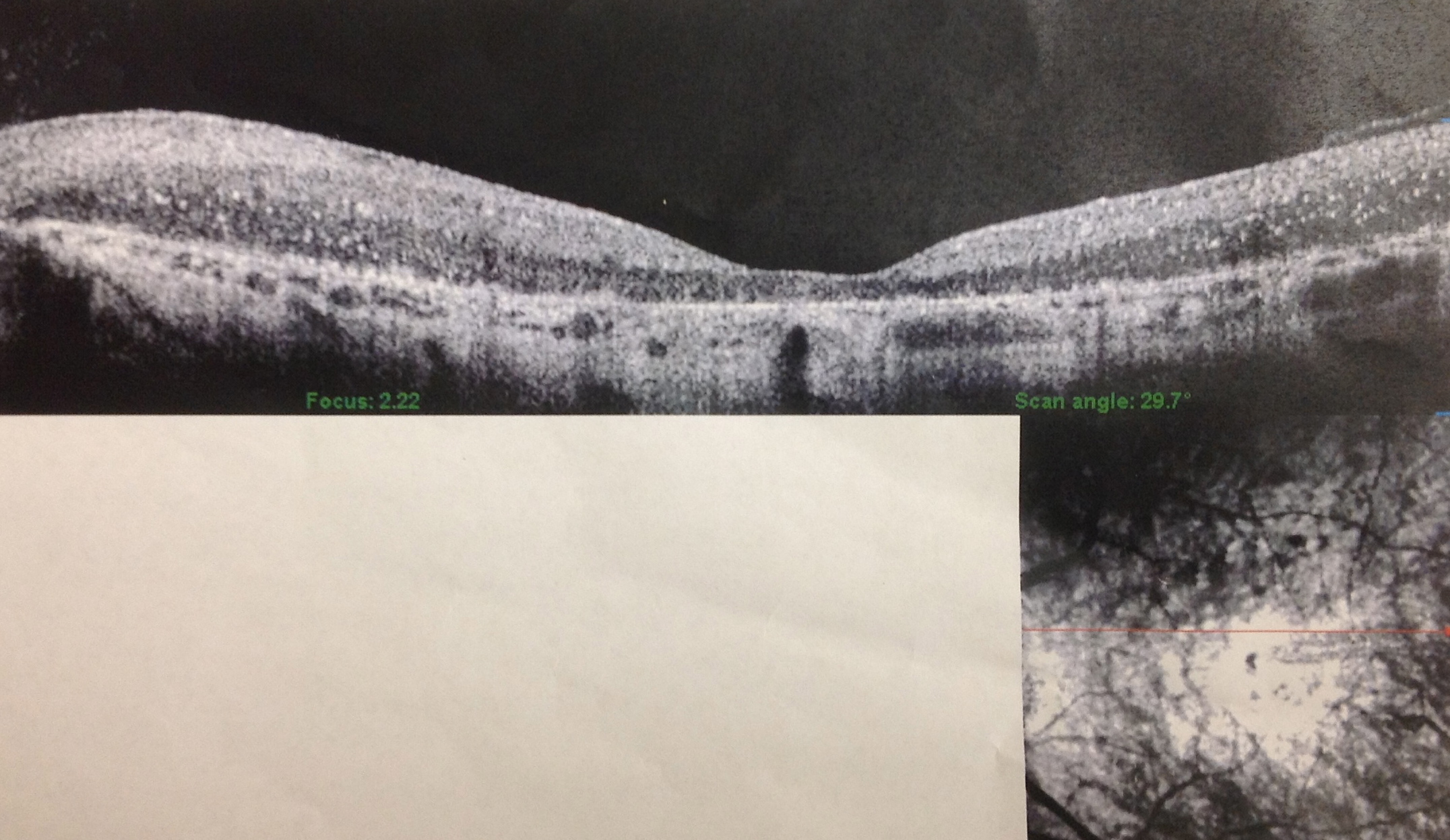
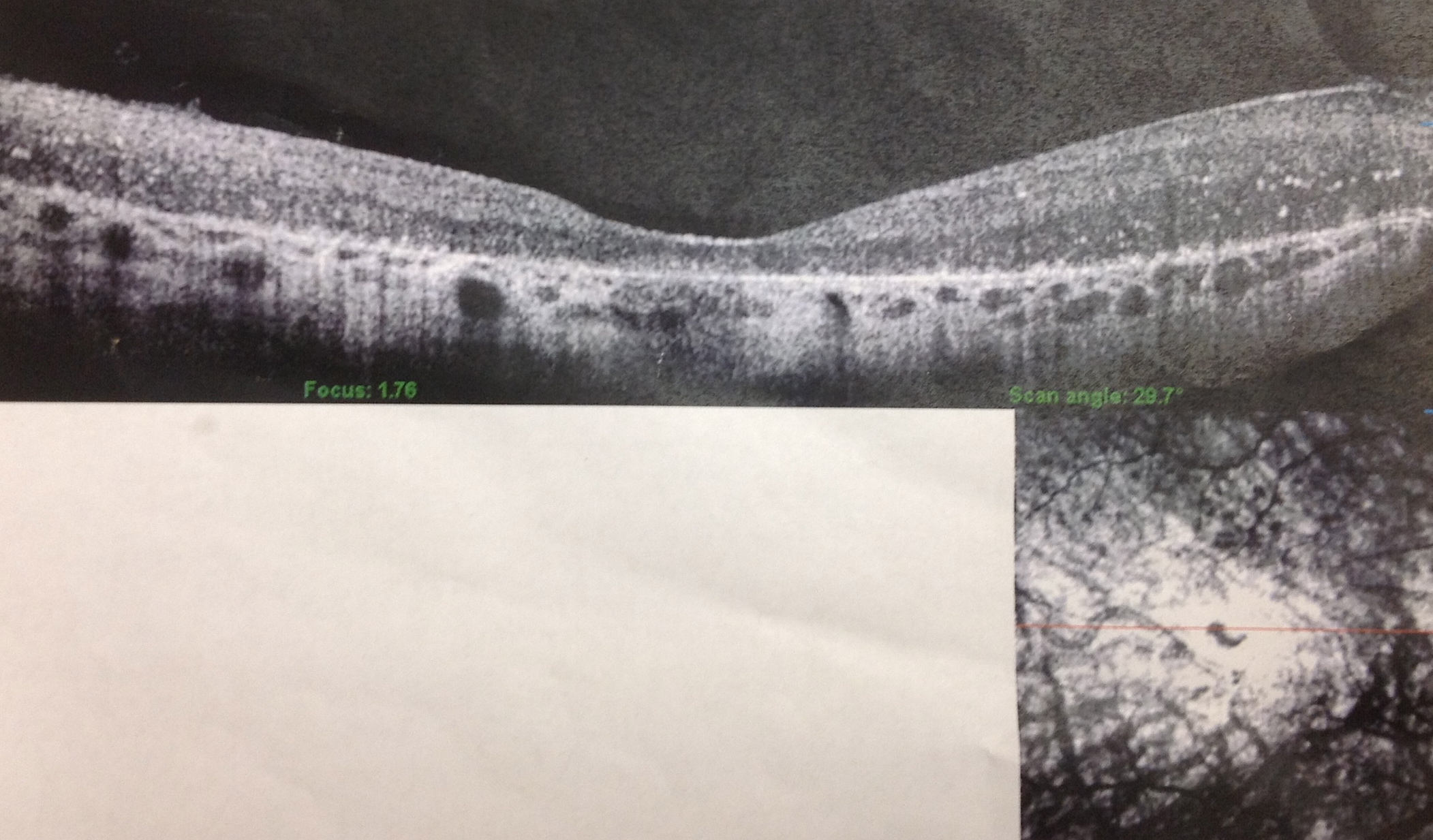
If you’re wondering what these two ultrasound-looking photos are, they are actually photos of my retinas taken at my most recent appointment. Like I said in Part 1, I learned a lot at this appointment, and the photos were just part of this wealth of information.

While I knew that I had a form of RP known as Lebers, I hadn’t realized that a 1995 blood test revealed the specific RP gene that Jenelle and I have; it is called the CRB1 Gene. This gene, unfortunately, is not the specific gene in clinical trials for gene therapy right now (the treatment that Dr. Fishman feels is the most promising within the near future).

Another gene, the RPE65 gene, is currently in human trials, and from what I gathered from Dr. Fishman, this is mostly due to the fact that it is one of the more common RP genes and that patients with RPE65 tend to have their central nuclear still intact, a necessary requirement for gene therapy

This is a new term I learned today, and they actually took pictures of my retinas to see if my central nuclears were still viable, meaning that the cells are alive and could therefore be receptive to gene therapy. This is, of course, all hypothetical considering the CRB1 gene is not currently in clinical trials. I naively asked whether it would be the next gene in trials, not realizing that there are many other RP genes that have also been identified that would be in the running. He said that research studies are more likely to take place with the genes that affect the most amount of people first. When asked how common the CRB1 gene is, he said it’s right in the middle. So there may be some waiting. He said that the results for the RPE65 gene are promising so far, however, and that once the initial FDA-approval process is over with, the following trials will be able to move at a much faster pace than the first one. Of course, even if the CRB1 gene begins human trials in the near future, Dr. Fishman pointed out that there are still many risks to weigh in whether Jenelle and I would want to volunteer to be among some of the first groups for treatment, especially considering they have to detach your retina during surgery, which could potentially decrease vision even further.

Dr. Fishman himself is involved more directly in some pharmacological studies that do similar work as gene therapy but are taken as medication rather than surgery. Some patients have had improved fields from this drug study, though the patient he was specifically testing did not have improved fields (but improved his acuity by 17 letters, which is substantial).

These are pictures of my retinas. The dark area in the periphery is scarring, or as Dr. Fishman put it, “charcoal ashes from the fire that is the disease”. The small white area in the center shows my central nuclear, which is still intact, though it is a very thin layer. The center of everyone’s retina is thin, but is extremely thin in patients with RP.

As far as other results from this visit, one major disappointment from Dr. Fishman moving offices is that a lot of records did not make it over yet, including my previous visual fields tests. I had been anxious to compare the results of today’s test to previous tests, but such is life Hopefully they will eventually find all of their files.

I did feel like my fields were pretty narrow during the test, but I think I am always surprised by how much I really can’t see when I take the fields test. Marty, my favorite technician who was doing my test, was particularly astonished that in my left eye– the one that can’t even see the giant E on the chart at 20/400, could still see a tiny pen-light in the center of the field test “All-be-darn” was his exact quote. Again, since they don’t have my previous records at the moment, I have no idea whether this is something I could see during my previous tests 3 years ago. While I did a fields test at my local eye doctor in Naperville this past fall, the test was not nearly as thorough, and the technician got really confused while doing the test because she had never done a test on someone with such low vision before, so I can’t use that one to compare to either.

Marty also said that he finds it fascinating how I am able to even walk from the waiting room to the exam room without any problem. He remarked on how the human brain compensates for the missing pieces of vision and fills vision in to make things look like a whole picture when there should really be no way to see the whole picture at all. He said with the vision I have, even walking around should be nearly impossible, but because my brain has filled in these pieces, I’m able to (even if it’s not always very well!) While I have had many of these same thoughts before, I was never sure if they had any actual scientific basis to them before hearing a professional say them.

As I said in Part 1, Dr. Fishman’s care for his patients was particularly evident to me during this visit I’m not sure whether it’s the new office environment or whether maybe I’m just better at asking specific questions now as an adult, but I feel like he took such care explaining extremely complicated scientific information in simple terms that I could understand.

I definitely plan on recording my next visit so that I can actually listen to it once I get home since there is way too much information to even begin to remember, much less reiterate to my family and friends later. Until then, I hope my modest attempt to convey pieces of info from the visit is helpful. Thanks for reading!

Return to Fishman: Part 1

20120620-100246.jpg

So I visited my childhood opthamologist and world-reknown RP researcher, Dr. Gerald Fishman last week. I have to say it was one of the most eye-opening visits I’ve ever had with him (and this is both pun and literal– you can always coulnt on your eyelids being pried wide open during an exam).

Back in the fall when I wrote, “Trip to Opthamologist” I was pretty darn honest about my memories of my visits with Dr. Fishman growing up, and I have to say that as I sat in his office, I kept cringing imagining if he were to ever see what I wrote “Fishbreath” isn’t the most flattering descriptor for a respected doctor.  (not that a famous researcher would ever be browsing through doublevisionblog!)

Dr. Fishman is now at the Lighthouse for the Blind in Chicago (rumor has it that it was a political upset that led to the switch from UIC Eye and Ear Infirmirary to the Lighthouse). I found it interesting that it wasn’t just the doctor himself who moved practices– his sidekick technician, Marty, who has been with him since 1996, was there to razz me with his usual goofy comments, so it felt like a little reunion of sorts, as I had not been to an appointment for a few years.

He also still had a Fellow working under him, Dr. Collingsby, and I kind of wonder if some of these younger doctors have been the ones teaching their mentor how to improve his patient-communication skills just as he has been teaching them about retinas, as I notice Dr. Fishman has become more personable over the years.  Or maybe it’s me getting older.  Or the new building he is in.

Dr. Collingsly examined me first, and though there were the usual bright lights shone stingingly in my retinas, he had clearly brushed his teeth and carried the aroma of soap, which beats many other potential smells.  He did still emulate Dr. Fishman’s audible, scientific terminology during the exam….. “asteroids in the center vitreous…..look up please……scarring in the outer……all the way to your right please….white lipids…..” which always cracks me up because I have no idea what any of it means, and most of it sounds like they’re looking through a telescope at the solar system, not my retina.

While I think part of the audible descriptors are for the sake of educating the doctors-in-training, the fact that Fishman mutters these terms to himself even when there are no other doctors present tells me that he is simply engrossed in what he does (or he says thing aloud to help remember them in order to write them on my chart maybe?)

True side story today: As Dr. Fishman has my left eye pried completely open with a bright light shining directly on my retina, he says something about looking at a beautiful universe of greens and blues and pigment mumbo jumbo and then mumbles “nothing to do with the RP but I can’t stop looking at these” and then chastises himself, saying “come on Fishman, back to work!” And I don’t think this was crazy-talk or senility or anything. I think he is so enamored with the human retina and all its details that he really, really loves what he does.

At one point I asked him the round-about question I always end up asking. And even though I know he can’t give me a clear answer, I can never stop myself from asking it in some form. So today I worded it, “So I think I remember you telling me that most patients you’ve seen who maintain usable central vision like I do are able to hang onto that bit of central vision for quite awhile”. And he said that’s true of people with 20/40 or better, and since I’m at 20/50, it’s really hard to tell. But what really got me today was that he kind of touched my upper arm and said genuinely, “Because each RP case is so different and there’s not a typical path for anyone, I cannot predict the outcome that you deserve to know.” He said I deserved to know what will happen with my vision. It isn’t possible, of course, but he said I deserved to know. And since I didn’t tape record him, I don’t even remember the exact quote– I think he said it better than what I quoted, but for the first time I felt his sadness in not being able to really help his patients– or even give them an accurate prognosis. How frustrating as a doctor.  Not to mention as a researcher who has devoted their career to finding a cure.

So I’m looking at this doctor– this researcher with the bow tie who speaks in scientific terms with fiery breath way too close to my face.  I stare at this small man who is frail and balding– the same one I dreaded seeing annually as a child– and he no longer appears as the villain. As a kid, your mind interprets events in crazy ways, and these difficult visits filled with bad news, poking and prodding definitely painted the doctor as the antagonist.

And I guess at this visit I grew up and saw how this “antagonist” has devoted his life to RP research well beyond the age most doctors retire (Marty-the-sidekick said he doesn’t know the definition of retirement!  Marty also would not tell me Dr. Fishman’s age, and I thought it would be weird to ask the doctor himself!).

Before leaving, Dr. Fishman asked, “have I answered all your questions?” and after saying yes and walking out of the office, I noticed he had been answering my questions for over an hour (on top of the 2 previous hours of tests)– an insane amount of time to spend with a patient these days.

And that’s the main reason I will make the trip to the city to see him each year instead of simply going to my local eye doctor.  I think any retina specialist can check for cataracts or fluid leaking in my retinas (two risks with RP), but I go to this particular specialist for the education. Yes, I could look online, but when you’re looking online, you really have to piece together a lot of information that may or may not be accurate.

For an update on what the appointment actually found vision-wise, please read part 2!