
Here’s a glimpse of how the girls and I wheel around town in all seasons:


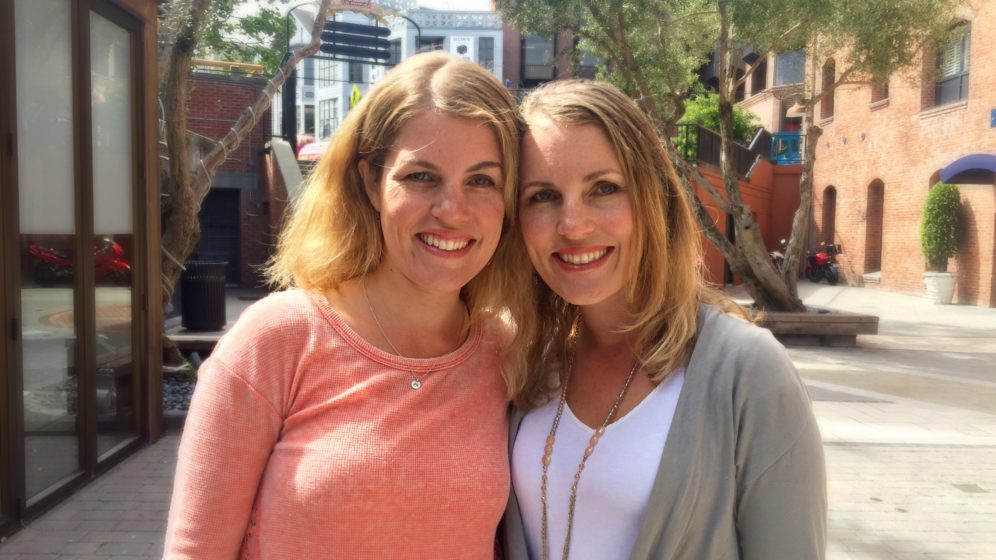
Here’s a glimpse of how the girls and I wheel around town in all seasons:
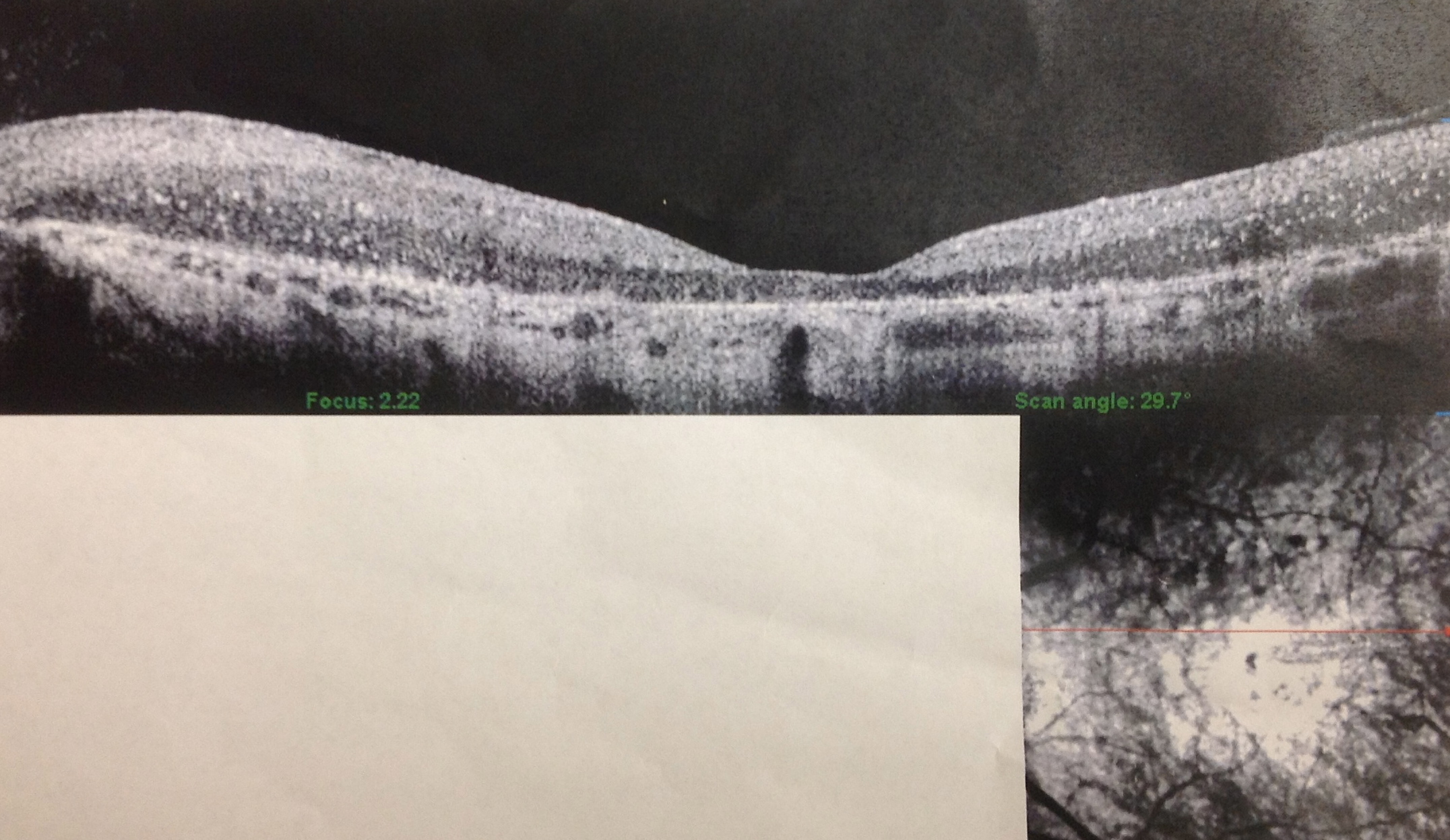
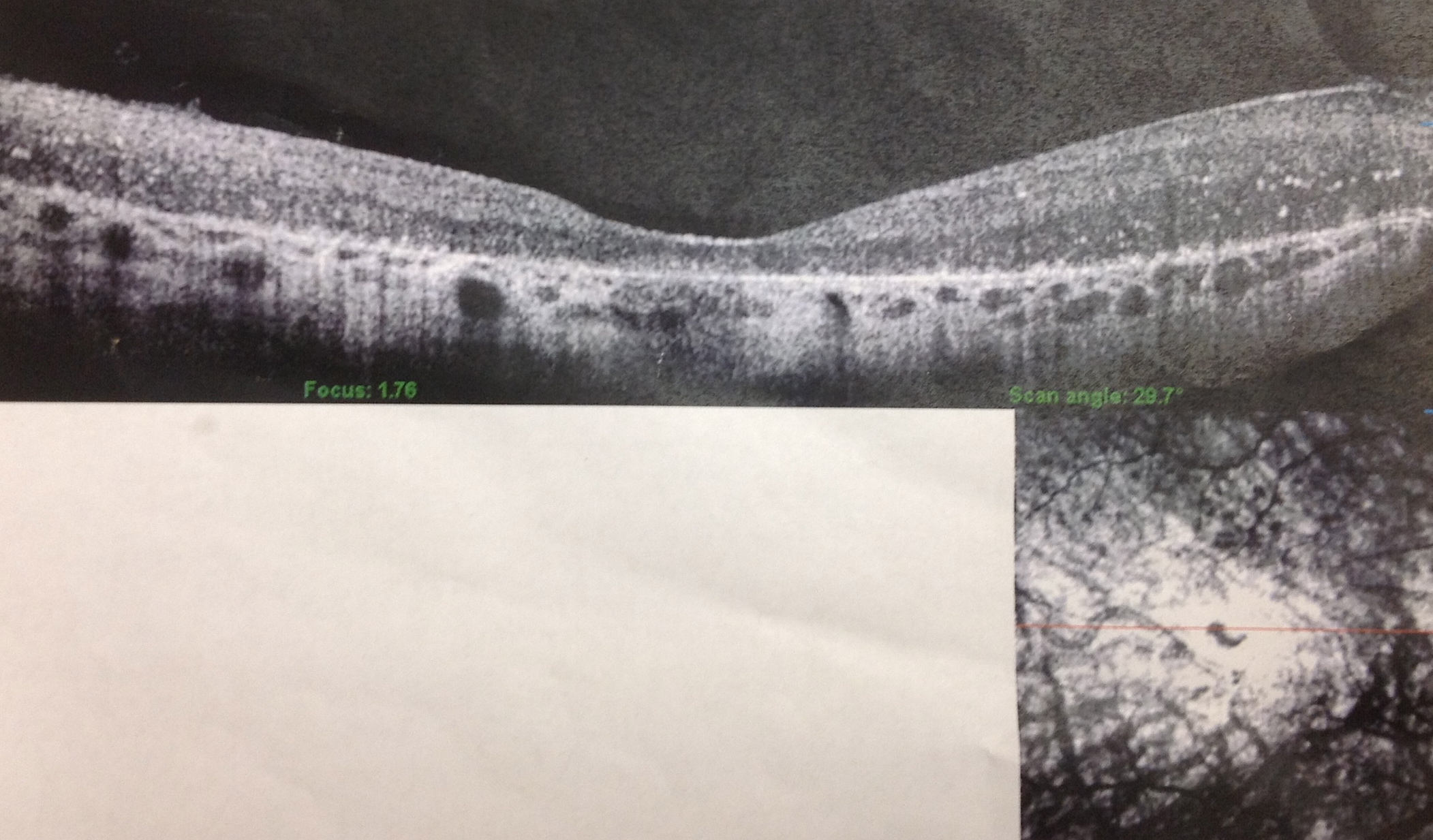
If you’re wondering what these two ultrasound-looking photos are, they are actually photos of my retinas taken at my most recent appointment. Like I said in Part 1, I learned a lot at this appointment, and the photos were just part of this wealth of information.
While I knew that I had a form of RP known as Lebers, I hadn’t realized that a 1995 blood test revealed the specific RP gene that Jenelle and I have; it is called the CRB1 Gene. This gene, unfortunately, is not the specific gene in clinical trials for gene therapy right now (the treatment that Dr. Fishman feels is the most promising within the near future).
Another gene, the RPE65 gene, is currently in human trials, and from what I gathered from Dr. Fishman, this is mostly due to the fact that it is one of the more common RP genes and that patients with RPE65 tend to have their central nuclear still intact, a necessary requirement for gene therapy
This is a new term I learned today, and they actually took pictures of my retinas to see if my central nuclears were still viable, meaning that the cells are alive and could therefore be receptive to gene therapy. This is, of course, all hypothetical considering the CRB1 gene is not currently in clinical trials. I naively asked whether it would be the next gene in trials, not realizing that there are many other RP genes that have also been identified that would be in the running. He said that research studies are more likely to take place with the genes that affect the most amount of people first. When asked how common the CRB1 gene is, he said it’s right in the middle. So there may be some waiting. He said that the results for the RPE65 gene are promising so far, however, and that once the initial FDA-approval process is over with, the following trials will be able to move at a much faster pace than the first one. Of course, even if the CRB1 gene begins human trials in the near future, Dr. Fishman pointed out that there are still many risks to weigh in whether Jenelle and I would want to volunteer to be among some of the first groups for treatment, especially considering they have to detach your retina during surgery, which could potentially decrease vision even further.
Dr. Fishman himself is involved more directly in some pharmacological studies that do similar work as gene therapy but are taken as medication rather than surgery. Some patients have had improved fields from this drug study, though the patient he was specifically testing did not have improved fields (but improved his acuity by 17 letters, which is substantial).
These are pictures of my retinas. The dark area in the periphery is scarring, or as Dr. Fishman put it, “charcoal ashes from the fire that is the disease”. The small white area in the center shows my central nuclear, which is still intact, though it is a very thin layer. The center of everyone’s retina is thin, but is extremely thin in patients with RP.
As far as other results from this visit, one major disappointment from Dr. Fishman moving offices is that a lot of records did not make it over yet, including my previous visual fields tests. I had been anxious to compare the results of today’s test to previous tests, but such is life Hopefully they will eventually find all of their files.
I did feel like my fields were pretty narrow during the test, but I think I am always surprised by how much I really can’t see when I take the fields test. Marty, my favorite technician who was doing my test, was particularly astonished that in my left eye– the one that can’t even see the giant E on the chart at 20/400, could still see a tiny pen-light in the center of the field test “All-be-darn” was his exact quote. Again, since they don’t have my previous records at the moment, I have no idea whether this is something I could see during my previous tests 3 years ago. While I did a fields test at my local eye doctor in Naperville this past fall, the test was not nearly as thorough, and the technician got really confused while doing the test because she had never done a test on someone with such low vision before, so I can’t use that one to compare to either.
Marty also said that he finds it fascinating how I am able to even walk from the waiting room to the exam room without any problem. He remarked on how the human brain compensates for the missing pieces of vision and fills vision in to make things look like a whole picture when there should really be no way to see the whole picture at all. He said with the vision I have, even walking around should be nearly impossible, but because my brain has filled in these pieces, I’m able to (even if it’s not always very well!) While I have had many of these same thoughts before, I was never sure if they had any actual scientific basis to them before hearing a professional say them.
As I said in Part 1, Dr. Fishman’s care for his patients was particularly evident to me during this visit I’m not sure whether it’s the new office environment or whether maybe I’m just better at asking specific questions now as an adult, but I feel like he took such care explaining extremely complicated scientific information in simple terms that I could understand.
I definitely plan on recording my next visit so that I can actually listen to it once I get home since there is way too much information to even begin to remember, much less reiterate to my family and friends later. Until then, I hope my modest attempt to convey pieces of info from the visit is helpful. Thanks for reading!

So I visited my childhood opthamologist and world-reknown RP researcher, Dr. Gerald Fishman last week. I have to say it was one of the most eye-opening visits I’ve ever had with him (and this is both pun and literal– you can always coulnt on your eyelids being pried wide open during an exam).
Back in the fall when I wrote, “Trip to Opthamologist” I was pretty darn honest about my memories of my visits with Dr. Fishman growing up, and I have to say that as I sat in his office, I kept cringing imagining if he were to ever see what I wrote “Fishbreath” isn’t the most flattering descriptor for a respected doctor. (not that a famous researcher would ever be browsing through doublevisionblog!)
Dr. Fishman is now at the Lighthouse for the Blind in Chicago (rumor has it that it was a political upset that led to the switch from UIC Eye and Ear Infirmirary to the Lighthouse). I found it interesting that it wasn’t just the doctor himself who moved practices– his sidekick technician, Marty, who has been with him since 1996, was there to razz me with his usual goofy comments, so it felt like a little reunion of sorts, as I had not been to an appointment for a few years.
He also still had a Fellow working under him, Dr. Collingsby, and I kind of wonder if some of these younger doctors have been the ones teaching their mentor how to improve his patient-communication skills just as he has been teaching them about retinas, as I notice Dr. Fishman has become more personable over the years. Or maybe it’s me getting older. Or the new building he is in.
Dr. Collingsly examined me first, and though there were the usual bright lights shone stingingly in my retinas, he had clearly brushed his teeth and carried the aroma of soap, which beats many other potential smells. He did still emulate Dr. Fishman’s audible, scientific terminology during the exam….. “asteroids in the center vitreous…..look up please……scarring in the outer……all the way to your right please….white lipids…..” which always cracks me up because I have no idea what any of it means, and most of it sounds like they’re looking through a telescope at the solar system, not my retina.
While I think part of the audible descriptors are for the sake of educating the doctors-in-training, the fact that Fishman mutters these terms to himself even when there are no other doctors present tells me that he is simply engrossed in what he does (or he says thing aloud to help remember them in order to write them on my chart maybe?)
True side story today: As Dr. Fishman has my left eye pried completely open with a bright light shining directly on my retina, he says something about looking at a beautiful universe of greens and blues and pigment mumbo jumbo and then mumbles “nothing to do with the RP but I can’t stop looking at these” and then chastises himself, saying “come on Fishman, back to work!” And I don’t think this was crazy-talk or senility or anything. I think he is so enamored with the human retina and all its details that he really, really loves what he does.
At one point I asked him the round-about question I always end up asking. And even though I know he can’t give me a clear answer, I can never stop myself from asking it in some form. So today I worded it, “So I think I remember you telling me that most patients you’ve seen who maintain usable central vision like I do are able to hang onto that bit of central vision for quite awhile”. And he said that’s true of people with 20/40 or better, and since I’m at 20/50, it’s really hard to tell. But what really got me today was that he kind of touched my upper arm and said genuinely, “Because each RP case is so different and there’s not a typical path for anyone, I cannot predict the outcome that you deserve to know.” He said I deserved to know what will happen with my vision. It isn’t possible, of course, but he said I deserved to know. And since I didn’t tape record him, I don’t even remember the exact quote– I think he said it better than what I quoted, but for the first time I felt his sadness in not being able to really help his patients– or even give them an accurate prognosis. How frustrating as a doctor. Not to mention as a researcher who has devoted their career to finding a cure.
So I’m looking at this doctor– this researcher with the bow tie who speaks in scientific terms with fiery breath way too close to my face. I stare at this small man who is frail and balding– the same one I dreaded seeing annually as a child– and he no longer appears as the villain. As a kid, your mind interprets events in crazy ways, and these difficult visits filled with bad news, poking and prodding definitely painted the doctor as the antagonist.
And I guess at this visit I grew up and saw how this “antagonist” has devoted his life to RP research well beyond the age most doctors retire (Marty-the-sidekick said he doesn’t know the definition of retirement! Marty also would not tell me Dr. Fishman’s age, and I thought it would be weird to ask the doctor himself!).
Before leaving, Dr. Fishman asked, “have I answered all your questions?” and after saying yes and walking out of the office, I noticed he had been answering my questions for over an hour (on top of the 2 previous hours of tests)– an insane amount of time to spend with a patient these days.
And that’s the main reason I will make the trip to the city to see him each year instead of simply going to my local eye doctor. I think any retina specialist can check for cataracts or fluid leaking in my retinas (two risks with RP), but I go to this particular specialist for the education. Yes, I could look online, but when you’re looking online, you really have to piece together a lot of information that may or may not be accurate.
For an update on what the appointment actually found vision-wise, please read part 2!

It seems like I’ve been talking to a lot of people who feel down lately. Some of the down feelings are
circumstantial, but for most of the people, it’s more of a disillusionment with the way their everyday lives are going.
And because I’ve definitely been there, it is causing me to analyze some of my “joy” data– and I’m not talking about my name here….. what brings joy into my life on an everyday basis? (and this is beyond all those easy answers like God and children….)
For me, it’s words. I remember loving the feeling of stringing them together as a kid…. that pure delight even in kindergarten when I wrote, “The Rose Girl” and had some vague sense that I had created something.
And maybe my first love of words had something to do with the fact that pictures were sometimes hard to see, and how the words describing them made them visible to me. My toddler has a lot of first words books where I point to the picture and she tells me what it is, and honestly thank goodness for the large, bolded words below each picture because I have trouble deciphering what most of them are even though she recognizes most of them right away.
I think it’s human tendency to withdraw from some of the things we really enjoy doing in life when we’re down. I know I withdraw from writing when I’m feeling depressed (hence the lack of entries over the winter!)
Yet as I write daily– whether I intend to ever share it with anyone or not– it makes me wish that I had forced myself to do it over the winter because I feel like the days build on each other and increases my daily joy exponentially.
it sometimes takes effort, contemplation and soul-searching to sit down and do the thing that feeds us– or even figure out what it is. But when it is found– whether it be yoga, art, long walks– whatever– give it a prominent place in your life. Challenge yourself in whatever it is, and ignore messages clouding your brain that tell you it’s a waste of time.
For years I didn’t really write much because I didn’t think it would ever lead to a “career” or financial gain. And honestly it may never end up putting a dime in my pocket, but I’d pay a whole lot of money to feel as alive as I do when I create with words. I am so grateful for my amazing twin sister who had the idea to start this blog. It has been my free therapy, my place to be honest, my place to grow and the place where my soul figures out it is satisfied.
I know I’m hovering on the cheesy side again, but I’m writing this for the people in my life who are down right now. Because they have soul food in their lives that they aren’t eating.
Usually these soul food type of activities don’t come skipping along at just the most opportune times. They usually arrive in the middle of the inconvenient times. Like right now when I’m supposed to be scoring essays, for example. I score state tests for Pearson from home to help pay bills (and with how slow I am at scoring, I barely make minimum wage, but my philosophy is that something is better than nothing!)
Many of my writing ideas enter my mind while I am scoring exams, which is completely frustrating because I have a quota to meet, and when I stop to write, I really lose time and money. But when I don’t grab those moments of inspiration, they tend to disappear. So lately, when I feel the inspiration to write, I stop whatever I am doing and just roll with it because I know it’s something that will keep building….. the more I am in the habit of dropping everything to do it, the easier it will be and the more joy I’ll get out of it, and the fuller my soul will feel.
And anyone I know who actually continuously practices the things that feed their soul end up heading in a life direction that they feel alive in.
My husband, for example, is a singer/songwriter, and for years he struggled to find his “niche” of listeners. I worked as his booking agent, we hired a publicist and were determined for him to someday make a living as a full-time singer/songwriter. After several years of late-night shows that didn’t really pay, I got really frustrated. Why wasn’t this career happening? But my husband kept plugging away writing and performing, and at times I couldn’t understand why.
Then in 2010 he was asked to do a Christmas show in Aurora, and we argued about whether he should do it because we would be sacrificing a lot of fun plans and even a weekend trip with family, for him to do this show that involved late-night rehearsals, performances spanning over two weekends and little pay.
At some point I remember my husband making the point that ended the argument: “Joy, with my busy job and our family commitments, this is my one opportunity each year to connect with other local musicians and to put music first”
And it was at that performance that he met his current boss, who hired him one month later to do his dream job. He now writes and plays music full time, like we had always hoped he would be able to do, and simply from continuing to do the thing that makes him feel alive even when it wasn’t convenient and didn’t pay.
I’m not suggesting that we will all end up with careers doing these soul food activities, but if we open up spaces in our days to do them and place them above all those nagging things like money and organizing the closets, we just might start to breathe easy again.


For as lovely as words can look on a screen, life can really blur them all together when you’re trying to live them out.
I hosted a Mother’s Day brunch at my house today for some of my extended family, which was filled with sunshine, great food and beautiful people. It was also filled with crap. Literally.
I won’t get graphic or anything, but I do want to share a little piece of this scenario to give you an idea of how very challenging it can be to place relationships and people first. I have a family member who is developmentally disabled and sometimes has bathroom issues. Well, let’s just say that today he had major bathroom issues. In both our bathrooms. And on the new bathroom rug. And even on the freshly-painted walls, discovered by my poor husband hours later.
When I first walked from the outside fresh air into our house and caught a whiff of this accident, my gag reflex went off, and I stepped right back out. Another family member graciously helped him clean everything up, though further setbacks and clean-ups seemed to continue for quite awhile. I found myself feeling disgusted and frustrated that this was all happening on Mother’s Day. And I found that I acted less than gracious and spoke in irritated tones.
As my family members were leaving, I told a couple of them about my blogpost on placing people first and how I couldn’t even post it because I felt like such a hypocrite acting like I care way more about people than my house but then feeling like I wanted everyone to just go away when it got messy. They smiled with understanding and joked that they wouldn’t tell anyone. I thanked my helpful uncle for all his clean-up work dealing with the other family member’s mess, to which he replied, “all small stuff”. And really, in the grand scheme of things, it is, and I know that as a whole.
And I tried to remind myself of that as my husband and I continued to do some aftermath clean-up later.
But the house still smelled like you-know-what, and I just wanted the nice scent of my Mother’s Day bouquet to fill the house as it had before the brunch.
Since we had to be at another gathering, we decided to just open up all the windows, and even left our front doors leading to the screened-in porch open in hopes that it would air out while we were gone.
And it did.
When we walked through the door this evening, the faint smell of cleaning supplies drifted,but mostly just the aroma of evening spring air filled the house. And it reminded me that sometimes all it takes is a few open windows. And there are windows I forget to open all the time. Not just in my house, but in my life.
I know I’m hovering on cheesy here, but it’s true. I remember to open the windows of all my thoughts, ideals, and insights to the world as I write this blog, but sometimes I forget to open the windows of acceptance to my own family members. Yes, I don’t have to love some of the things they do, and there are definitely boundaries I need to set with certain people who choose not to work on their issues, but there’s usually room for more kindness and acceptance even when setting boundaries.
For example, this particular family members was mentally capable of taking some medication that could have prevented these accidents today but chose not to, and he also chose to eat food that he knows upset his stomach, and because of that, he will not be asked to the next gathering at my house. But at the same time, I didn’t even take the time to say goodbye to him today. I could have still hugged him good-bye and shown love despite my frustration.
I think in order to place people first in our lives, we need to challenge ourselves in the ways that we think about others and act toward them, especially with the difficult people.
There are always more windows that can be opened. And always more fresh air we can let in.
I want to freeze time. To capture the light blonde and brown tendrils that fly all wispy as my daughters dance around the kitchen putting on “dinner entertainment” for daddy . He eats and laughs, more amused by these two under 4 ft. tall than he probably ever imagined he’d be. I want to put their little sing-song voices in my leftover packing boxes with heavy packing tape so that they will never escape me. I want these little years– the ones when they want to play all day – and beg me to stop doing laundry so they can just be with me for 5 minutes — to last.
As I was trudging up the stairs exhausted the other night, I tried to recap in my mind all the things I had accomplished during the day. I became a little agitated because I couldn’t think of many things I had crossed off my growing to-do list. But then I remembered the important 2 hours I’d spent crawling on colored carpet squares.
The girls and I had gone with Ben to the church where he works because I was meeting some friends there, and since we needed to wait for his meetings to end before leaving, we spent the whole day there.
We went into the K-5 room which has these fun, colorful carpet circles and began inventing all different kinds of games. I was a chomping alligator in hot lava while they were toads hopping from circle to circle. I was the leader of a secret “flower” club up on the little play balcony. We were robots that could only jump to certain colored islands.
We ran and laughed and played till we were slap-happy with fatigue. And while those 2 hours of fun were clearly not on my list of things that really needed to get done, I went to bed feeling satisfied that night.
I’ve noticed that since living in a walkable area and having the ability to run a lot more of the errands during the day, my days are sometimes packed. I also took on a part-time job scoring essays from home this month, so the to-do lists seem to be multiplying.
I ended up needing to create a separate list of things entitled “important things”, and I try to make sure that even if some of the things on my regular to-do lists don’t get accomplished, I at least do the important things each week.
Most of the important things involve people, and one of those is my 82-year-old grandmother who lives 3 blocks away and recently was told to stop driving. This a little more difficult for her because she doesn’t have the strength of a 33-year-old to walk all over town like I do. So one of the new “important things” on my list each week is to take the girls to visit her– not out of obligation or anything, but because I value time with her and know it helps lighten her day at a difficult time in her life.
Sometimes this means grabbing a 45-minute window of time, leaving the kitchen a mess or a chore undone, to go spend time with her. And while I wasn’t raised to be okay leaving a mess, I think sometimes in order to put people first in our lives– not our houses or material things– it’s necessary. Obviously, there comes a time when things really do need to get cleaned up, and I don’t want us living in a disgusting mess or anything, but loosening our reigns on how perfect the house should look at all times can open up space for our relationships to grow.
When I’m 82-years old like my grandma, I hope that my phrase of satisfaction reads something like this: “My life is full because I put first things first in my life. I put relationships and people in front of my stuff.” as opposed to, “Wow, I have had a perfectly clean house for the past 82 years– how full and satisfying life is.”
So this post used to end right here, and there was no “part 1” in the title. That was a week ago when I thought that this was the easiest, simplest concept in the world…… when sunny strolls to grandma’s house trumped dirty dishes in the sink (okay, they still totally do, only I’ve realized that sometimes extra complications arise that challenge our ideals…. and that’s why there’s a part 2, so stay tuned if you can relate!)

If you read “Moving Forward,” you know the story – the desire to make a change, the sacrifice it often takes to do so, and the shifts in perception that Continue reading “Reclaiming Our Lives”
It’s been a rough few months. Our entire family took turns suffering from everything from the stomach flu to pneumonia, I went through a miscarriage and bad reaction to anesthesia, and we moved from my in-laws’ house (where we lived for 8 months.) in the middle of it all. Oh, and did I mention that my husband is in ministry? . . . And given that this all was happening right before Easter, his schedule was pretty crazy.

So this move — though it occurred at a difficult time — was a move forward. If you’re wondering how this relates to RP, I’ll give you a little of the back-story on why we chose to Continue reading “Moving Forward: And All These Privileges”
We are excited to share our contest winner, Tracey Westphal’s, poignant and inspiring piece with you. Tracey has a very interesting perspective, as both her father and twin sons are affected by RP. As visually-impaired parents, it’s often difficult to think about how our kids view us, but reading Tracey’s memories of her father is definitely uplifting. And reading her insights on raising children with RP is encouraging for any parents struggling to find the balance between pain/worry and knowing your kids will be okay despite their RP. Thank you, Tracey, for your honest and hopeful account.

Learning Lessons
Growing up with a “legally blind” father may seem like a unique experience but for me and my sister, it was our normal. Dad took the bus to work every day. As little girls, we would run to the bus stop to greet him at day’s end. Our life wasn’t like everyone else’s. Life was a little different. My mom was the only driver. Plus, we weren’t allowed on the grass at all once Dad started the mower. Still, we stood on the wooden deck and directed him with our shouts when he didn’t mow in straight lines and left “Mohawks” in the grass. I never really viewed my dad as a “blind guy”. He was just my dad. Oh, and by the way, he was blind.
I loved the stories he would tell. At 15 years old, he had decided not to take driver’s training because he knew he would never pass the vision test. Apparently, his friends talked him into taking the class anyway and he just turned the wheel and braked when they told him. “Dad, I can’t believe they let you do that!”
“Well,” he would answer with a smile, “I did pass the class. They didn’t give you the vision test until after the training. ” I never thought how sad his teenage heart must have been that he could never drive. He never mentioned it.
Dad and I would walk to the nearby mall for a “date with dad” and buy dessert. While shopping, he would sit patiently outside the dressing room for hours while his daughters paraded around in whatever we wanted to try on, usually the fancy gowns people bought for cruises. “How do I look, Dad? This one is blue.” “You look beautiful,” he would say. And even though we both knew he couldn’t really see me, my heart would still fill with happiness and I would feel beautiful and very loved by my Daddy.
But now, I am the grown up. I am the mom, and my little boys were diagnosed with that same disease last year. We all talked about it at the kitchen table so my twins are aware of their condition. Their older siblings often help them find things that fall on the floor or call to them when we are in a new environment.
But I have those mommy moments. Last September, Marcus ran right into a picnic table bench full speed. I knew he had seen the table but the bench was outside of his field of vision. He looked down in surprise after the collision. I headed over to comfort him but a bruised knee didn’t matter to this active boy. He just brushed himself off and kept following his older brother’s call. Yet, my mommy eyes welled up with tears. I don’t want this for my boys! My heart seemed to scream. It doesn’t matter now, my mind reasoned back, and you’ve got to make the best of it.
This pattern still continues as I listen to bedtime prayers, “and dear God, pretty please have a doctor learn how to fix my refinit retinit pigmona! Please, please”. My eyes blink back the tears as my heart grieves and my brain says, “Never let them see you cry; be brave and strong for your boys, tell them what they can do, and let them try anything. Remind them God has a plan.”
Not every day is like that. My Lucas and I had an early morning cuddle, “Mama, will I grow up to be like blind like ‘Papa’?”
“Maybe,” I answer truthfully, “maybe not.”
“Well, that wouldn’t be so bad,” he answers, “Papa is very strong, and he can even listen to the Bible on tape!”
I am so grateful for an active Dad whom I have never seen wallow about his blindness, but simply accept it and move on. I don’t think the words, “I can’t” are even in his vocabulary. As a young man, he exercised as an avid runner, eventually using a sighted guide to finish his races. Now, in his older years, he loves to snowshoe and sled with my kids, spending hours outside with them until they are all redfaced and chilled. He has an exercise room in his basement and the kids love to listen to his radio and exercise with their Papa. It’s even entertaining to me to hear my daughter say, “Oh, my Papa taught me how to hula-hoop, but his record is 392 times! I haven’t beat it yet, but I will.”
So while my mommy grief threatens, my mommy hope is proving stronger. These happy boys who I love so much will someday grow into men. What their sight will be then we do not know, but I hope and pray their vision for life will be strong, just like my Dad’s.
—–
Honorable Mention: Jean Porter (note: With the driving issue being such a difficult one, this story definitely resonates with any person dealing with the hard, disappointing facts of vision loss. Thank you, Jean, for sharing your son’s realization and acceptance.)
From a very young age my son, David would comment when we were out in the car, that when he was old enough he would help me out with the driving.
At the time I was divorced with 4 small children and each time he mentioned it I would wonder how on earth I was going to tell him that his eyesight was not good enough to drive.
When he was about 9/10 years old we were heading home one evening, there was just the two of us in the car and he suddenly asked where we were. I told him where we were and he just said “Mum, they won’t let me drive, will they?” I said “No David, I’m sorry they won’t.”
He never mentioned helping me out with the driving again and I breathed a sigh of relief knowing that he realised himself that his sight was too poor to drive and I didn’t have to tell him.
He’s 21 now and recently we talked about his vision and finding a cure for Retinitis Pigmentosa. He told me that he would be happy if someone could stop the deterioration so that his vision wouldn’t get any worse, but he biggest regret is that he would never be able to drive!
In case you haven’t heard, today is not just Leap Day – it’s also Rare Disease Day. “Alone We Are Rare, Together We Are Strong” is the tagline for this campaign, and I think it’s a brilliant idea. Public awareness can help living with diseases like RP a lot easier. For example, I recently heard about a woman with RP and her guide dog being asked to leave a restaurant because the owner saw her reading the menu. He didn’t believe that the guide dog was necessary since this woman could see enough to read. He had obviously never heard of RP or being partially-sighted. Many of these diseases, including RP, are rarely included in mainstream media, so it’s no wonder that the public remains ignorant of these diseases. “Most of the conditions the Foundation targets are considered “rare” because they affect less than 200,000 Americans and stem from defects in nearly 200 different genes. According to the National Institutes of Health (NIH), there are nearly 7,000 rare diseases affecting approximately 30 million (or 1 in 10) Americans” www.blindness.org
I wish that I could say that having RP has helped me not to be as ignorant as the previously mentioned restaurant owner. However, a few years ago I had an experience that showed me how insensitive I can be. When I worked for a consulting firm in Seattle, one of my main responsibilities was planning social events for the consultants. I remember feeling slighted because one of my colleagues always left the events early and never brought her husband to any of the activities I planned – she always had a different lame-sounding excuse as to why he couldn’t join us. But after I got to know her better, I learned that her husband has early on-set Parkinson’s disease, and was too embarrassed about it to come to the events, and that she frequently had to leave events early because she needed to get home to help care for him. I remember feeling so ashamed of myself for assuming that she was just a flake and not giving her the benefit of the doubt. I know this is something that we’re all guilty of to some degree.
My husband and I were just chatting with some friends over brunch on Sunday about how RP has affected our lives and my husband shared some really good insight. He said that my RP has caused him to give others the benefit of the doubt more. If someone bumps into him on the street, he doesn’t automatically think, “What an inconsiderate jerk!” or “Watch it buddy!”. Instead, he thinks to himself, “Maybe there is a reason that person accidentally bumped into me that I don’t know about”. You really never know what someone else is going through, so why not have a little extra grace for that stranger, neighbor, co-worker, family member, friend, etc. that does something that you find a little bit odd or even rude. A little compassion goes a long way.
In addition to public awareness, Rare Disease Day aims to encourage politicians to increase funding to the National Institutes of Health and the medical research it conducts. Join me in participating in Rare Disease Day by signing this petition now.